




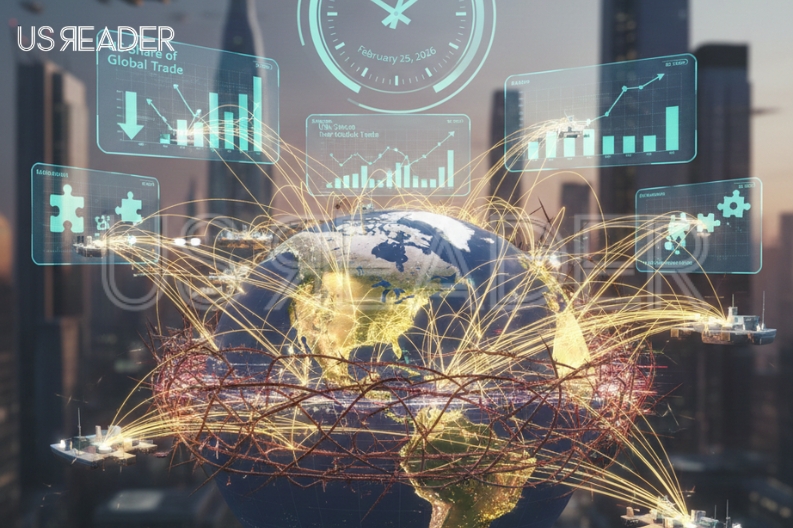
Is the World Leaving the U.S. Behind on Trade? Many experts now say: yes. Furthermore, the data backs it up. The U.S. share of global trade is falling fast, and countries around the world are moving on – signing new deals and finding new partners – while America stays stuck in a cycle of tariff uncertainty.
Quick Facts: U.S. Trade at a Glance
| Indicator | What’s Happening |
| U.S. share of global trade (2024) | 12% – falling to 9% by 2034 (BCG) |
| China’s exports to U.S. (2018 vs now) | Down from 19% to 11% |
| Average U.S. tariff rate (post-SCOTUS) | ~9.1% if Section 122 expires; up to 13.7% if extended |
| Average household cost of tariffs | ~$800 per year in lost income |
| New EU trade deals signed (2025-26) | Mercosur, India, Mexico, Indonesia |
| IEEPA tariff revenue collected | ~$165 billion (through Jan 2026) |
The Big Picture: Why Countries Are Moving Away from the U.S.
For years, the United States was the center of global trade. However, that position has been slowly slipping away. Since 2016, the U.S. has pulled back from global trade agreements. Moreover, since 2025, the pace of that retreat has sharply increased.
Columbia University professor Jeffry Frieden explains: countries like Canada, Japan, and EU members feel they can no longer rely on the U.S. as a stable trade partner. As a result, they are actively looking for alternatives.
Canada, for example, recently made a limited trade deal with China – something that would have been unthinkable a decade ago. Additionally, Canadian tourists are now vacationing in other countries as a form of quiet protest against U.S. economic pressure.
What Happened With the SCOTUS Ruling? (February 2026)
On February 20, 2026, the U.S. Supreme Court ruled 6-3 that the president cannot use the IEEPA (International Emergency Economic Powers Act) to impose tariffs. This was a landmark decision. Nevertheless, it did not end tariffs altogether.
Within hours, President Trump responded by announcing a 10% temporary import surcharge under Section 122 of the 1974 Trade Act. Furthermore, he later announced plans to raise it to the legal maximum of 15%. These new tariffs expire automatically after 150 days – unless Congress votes to extend them.
Winners and Losers After the SCOTUS Ruling
| Country / Region | Impact |
| China & India | Relative winners – previously faced higher IEEPA tariffs |
| UK & Australia | Relative losers – had 10% deals, now face same rate as others |
| EU, Japan, South Korea | Neutral on headline rate but lose competitive advantage |
| U.S. Consumers | Still paying ~$800/year more due to remaining tariffs |
| U.S. Importers | Some relief on consumer goods; refunds uncertain, may take years |
Who Benefits Most From America’s Trade Retreat?
The answer is clear: China. Even though U.S. tariffs pushed Chinese goods out of American stores, China simply found other buyers. In fact, Chinese exports and trade surpluses have continued to grow because of what economists call “the great reallocation” – shifting sales to Southeast Asia, Africa, Europe, and Latin America.
Meanwhile, countries like Brazil, India, and Chile are all reporting record exports – but mostly to China and other non-U.S. markets. Therefore, the tariffs didn’t hurt China’s economy nearly as much as intended. Instead, they reorganized China’s trade while expanding Beijing’s global influence.
The World Is Making New Trade Deals – Without the U.S.
While the U.S. focuses on tariff battles, the rest of the world is quietly building new partnerships. Here is a summary of major deals signed recently:
- EU + Mercosur (South America) – covers ~1 billion people, eliminates 90% of tariffs
- EU + India – one of the largest bilateral trade deals in history
- EU + Mexico + Indonesia – updated and new agreements
- India + UK, Oman, and New Zealand – multiple new pacts finalized
- China + ASEAN – upgraded existing agreement
- Canada + Indonesia – a new separate bilateral deal
Importantly, many of these agreements were specifically designed to reduce dependence on U.S. trade policy. In other words, these countries aren’t just trading more – they’re building a safety net against American unpredictability.
What Does This Mean for Everyday Americans?
The economic consequences are real and affect ordinary people. Here is what U.S. families and businesses are facing:
- Higher prices: Consumer goods like clothing, shoes, and electronics cost more
- Fewer choices: Trade barriers reduce the variety of products available
- Job uncertainty: Industries that depend on global supply chains face disruption
- Weaker dollar: Investors are reconsidering U.S. assets, weakening the greenback
- Isolated supply chains: A nationalized supply chain creates risks – like the 2022 baby formula shortage
Bottom Line
So, is the World Leaving the U.S. Behind on Trade? Based on the evidence, the answer is yes – gradually but clearly. The U.S. share of global trade is shrinking. New alliances are forming without American involvement. Furthermore, American tariff policy has become so unpredictable that even close allies are planning their futures without Washington at the center. The window to reverse this trend is still open, but it is closing fast.