



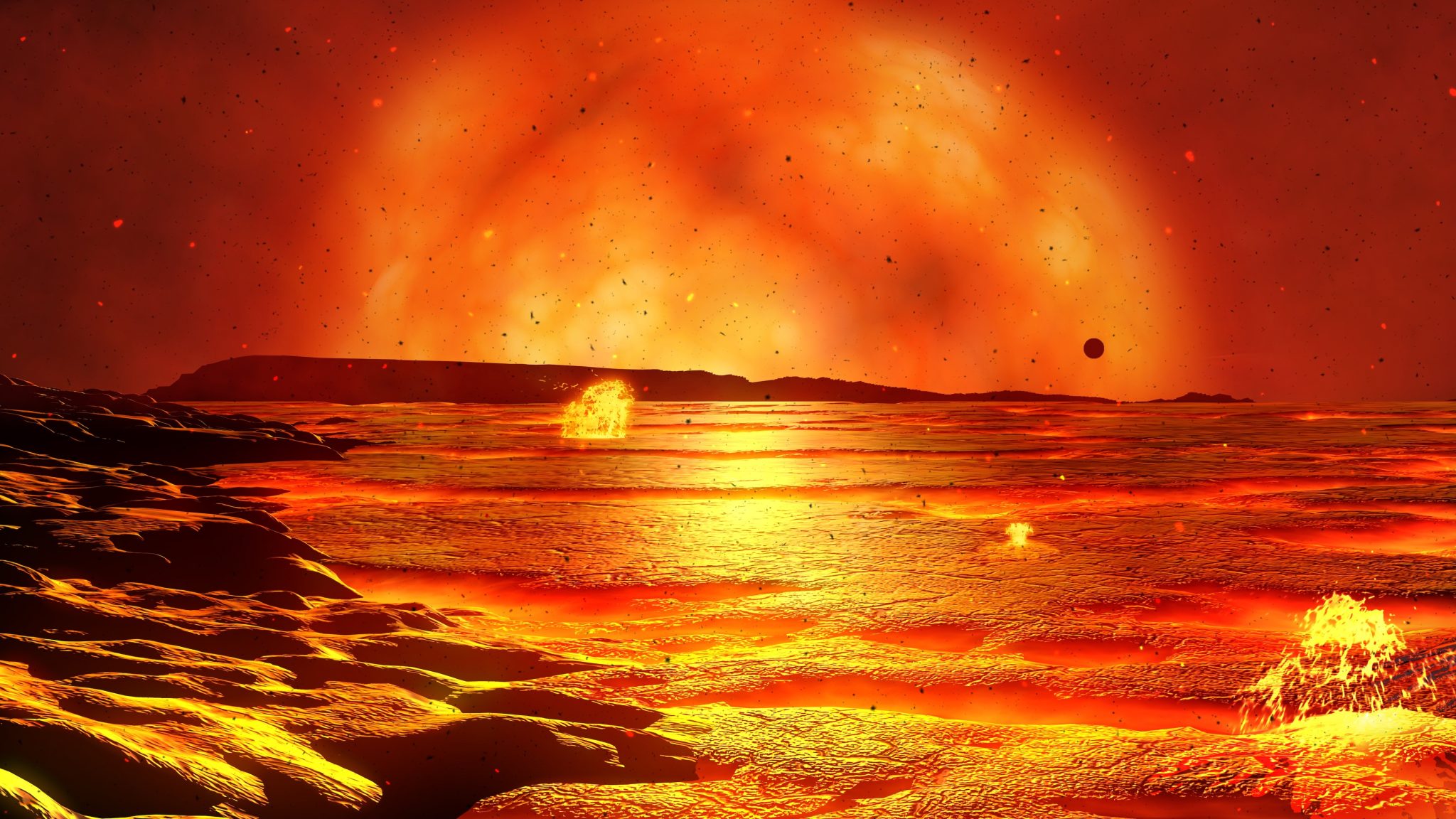
Imagine, for a moment, the end of the Earth.
Humanity has wrestled with that idea for as long as we have told stories. Across continents and centuries, we have imagined the sky splitting open, oceans swallowing the land, fire falling from the heavens, or ice tightening its silent grip around a fading world. From ancient myth to modern science, we return to the same enduring question. How does this story end?
Recently, that question resurfaced in public debate. Elon Musk invoked the eventual destruction of Earth to defend his vision of a multiplanetary civilization. Around the same time, scientists announced the discovery of an Earth-like planet that survived the death of its own star. That finding offered a rare and humbling glimpse into what may await our own world billions of years from now.
Even with our growing knowledge, uncertainty remains.
Our Sun burns steadily at the center of our solar system. It has done so for about 4.6 billion years. It fuses hydrogen into helium and releases energy that warms our oceans and lights our skies. Yet the Sun does not remain unchanged. It grows brighter and hotter over time. In about two billion years, that steady increase in luminosity will evaporate Earth’s oceans and erase the conditions that allow life to thrive. Long before the Sun dies, Earth will become dry, hostile, and unrecognizable.
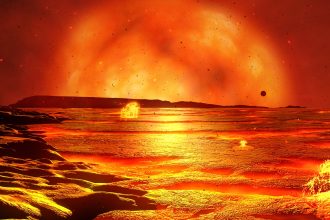
Five to six billion years from now, the Sun will exhaust its hydrogen fuel. It will swell into a red giant and expand to more than one hundred times its current diameter. Mercury and Venus will almost certainly disappear inside that expanding star.
Earth’s fate remains uncertain.
Melinda Soares Furtado, an assistant professor of physics and astronomy at the University of Wisconsin Madison, studies planetary engulfment. She explains that the line between survival and destruction rests on a narrow margin. If Earth orbited slightly closer to the Sun, scientists could confidently predict its fiery end. But the boundary between safety and engulfment lies only a few percentage points away in orbital distance. Small uncertainties in our models prevent definitive conclusions.
In other words, the final chapter of our planet’s story has not yet been written.
When science leaves room for ambiguity, humanity turns to reflection. We search our myths, our philosophies, and our poetry. And we discover that long before we calculated stellar expansion, we imagined the end with remarkable clarity.
Some traditions never assumed the universe would end at all.
Tim Burbery, a professor of English at Marshall University who studies geomythology, reminds us that Aristotle argued for an eternal universe. For centuries, that belief shaped intellectual thought. Even when scientists introduced the Big Bang theory, some resisted the idea, partly because it contradicted the deeply rooted assumption that the cosmos had no beginning and no end.
Helen Van Noorden, associate professor in classics at Girton College at the University of Cambridge, notes that many ancient philosophies expected the world to continue indefinitely. They believed the cosmos existed to persist, even if civilizations rose and fell within it.
Yet even cultures that imagined continuity often told stories of destruction.
Zoroastrian tradition describes a Sun that stands still for ten days while earthquakes shake the Earth. The Talmud speaks of a 6,000 year span of existence followed by 1,000 years of desolation. Christian interpretations of Isaiah and the Second Epistle of Peter describe a fiery purification that leads to the creation of a new Earth. The Stoic philosopher Seneca wrote in his Consolation to Marcia about a cosmic destruction by fire, not to inspire fear but to help individuals place their own grief within a larger perspective.
Across cultures, two powerful images appear again and again. The world ends in fire. Or the world ends in silence.
Robert Frost asked whether the world would end in fire or ice. T. S. Eliot wondered whether it would conclude with a bang or a whimper. These poets did not analyze astrophysics, yet they captured a truth about the human spirit. We instinctively frame cosmic destiny in human terms.
Ricardo Yarza, a graduate student in astronomy at the University of California Santa Cruz, suggests that modern astronomy challenges our long held anthropocentrism. For centuries, we imagined ourselves at the center of creation. We assumed permanence. We assumed protection. Science reveals a different reality. The universe does not revolve around us. It follows physical laws that preceded humanity and will continue long after we are gone.
That realization can unsettle us. But it can also humble us.
We exist at a specific moment in cosmic history. Even the Sun and Earth, which seem eternal in our daily lives, represent temporary alignments of matter and energy. They formed from interstellar clouds. One day, they will disperse back into space. That knowledge does not diminish our lives. It sharpens our appreciation for them.
Soares Furtado emphasizes how extraordinary Earth’s journey has been. Our planet has remained in the habitable zone for billions of years. That stability allowed simple chemistry to evolve into complex life. No other planet in our solar system has enjoyed such a sustained opportunity. Oceans formed. Atmospheres stabilized. Life diversified. Consciousness emerged.
We often call Earth ordinary because it orbits an ordinary star in a typical galaxy. But when we examine the details, we see something rare. Earth maintained the delicate balance necessary for life across immense spans of time.
Eventually, that balance will break.
As the Sun evolves into a red giant, it will lose nearly half of its mass. Stellar winds will carry material outward into the surrounding cosmos. If Earth survives engulfment, it may drift into a wider orbit as the Sun’s gravitational pull weakens. If it does not survive, the Sun will incorporate its remnants into expanding clouds of gas and dust.
From that debris, new stars and planets may one day form.
In that sense, destruction does not mean oblivion. It means transformation.
Many mythologies anticipated this cycle. Norse tradition describes Ragnarok, a catastrophic battle that gives rise to renewal. Hindu cosmology envisions cycles of creation and dissolution repeating across cosmic time. Modern astrophysics echoes those themes. Stars forge heavy elements in their cores. They explode or shed their outer layers. Those elements seed new systems. The atoms that compose our bodies once lived inside ancient stars. One day, they will return to the cosmos.
We find ourselves, then, contemplating two symbolic futures. One envisions Earth consumed in a final blaze. The other imagines Earth surviving as a cold, lifeless relic orbiting a fading stellar core.
Tim Burbery admits he leans toward the fiery conclusion. He finds meaning in the idea of a decisive ending. Fire, in many traditions, represents purification. It signals closure and prepares the ground for renewal.
Others prefer the idea that Earth might endure as a silent monument to a once living world.
Our preferences do not influence orbital mechanics. But they reveal something about us. We want endings to carry meaning. We want our story to resolve with dignity.
When Elon Musk advocates for colonizing Mars or building settlements beyond Earth, he frames it as a response to planetary vulnerability. He argues that long term survival demands expansion. His vision reflects both ambition and foresight. He recognizes that Earth’s habitability has limits, even if those limits lie billions of years away.
Yet perhaps the deeper lesson lies closer to home.
The Sun’s red giant phase will not arrive for billions of years. But environmental challenges confront us today. Climate change, biodiversity loss, and ecosystem degradation unfold on timescales we can influence. The distant fate of Earth does not excuse neglect. It invites stewardship.
If we understand that our planet’s habitability represents a rare and temporary window, we should protect it with urgency. We cannot prevent stellar evolution. But we can shape the conditions of the centuries ahead.
Yarza offers a perspective that resonates. He acknowledges that thinking about planetary engulfment unsettles us. Yet he also finds the knowledge cathartic. When we recognize impermanence, we gain clarity. We see that permanence has always been an illusion. We learn to cherish the present.
Today, we possess tools that previous generations could scarcely imagine. We detect exoplanets orbiting distant stars. We model stellar evolution across billions of years. We reconstruct the chemical history of galaxies. We pair scientific rigor with ancient wonder.
In doing so, we join a long human tradition of reflection.
Whether Earth ends in flame or persists as a lifeless husk, the broader truth remains. The universe evolves. Stars ignite and fade. Galaxies merge. Matter rearranges itself into new forms. Our planet’s story will fold into that vast narrative.
But for now, we stand beneath a stable Sun. We breathe air rich with oxygen. We watch seasons change. We build communities. We write poetry. We launch telescopes into orbit. We ask questions that stretch beyond our lifetimes.
That reality carries profound meaning.
Perhaps the most important response to Earth’s eventual fate does not lie in choosing between fire and silence. It lies in recognizing the improbable gift of existence itself. We inhabit a world that sustained life for billions of years. We possess the intelligence to understand its origins and anticipate its distant future.
One day, the Sun will determine Earth’s final chapter. But today, we determine how we live within it.
And if history teaches us anything, from ancient myth to modern astronomy, it teaches us that endings often give way to beginnings. In that truth, we find both humility and hope.