



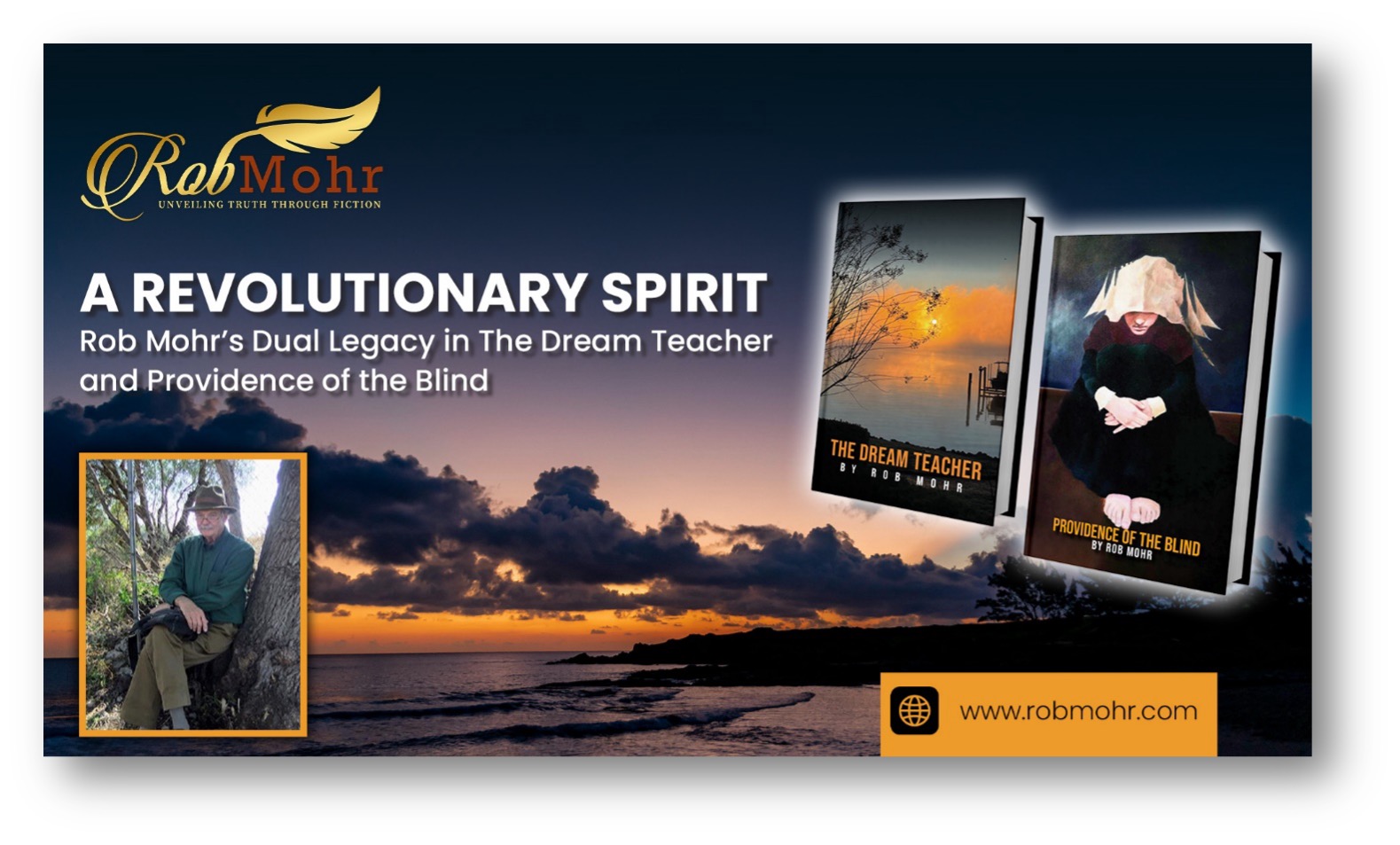
What if a novel could wake you up—not just to a story, but to the truth of the world around you? In The Dream Teacher and Providence of the Blind, author Rob Mohr doesn’t just tell tales— He exposes the inner workings of power, the quiet heroism of resistance, and the aching beauty of human connection. “I write to wake people up,” he says—and that’s exactly what his books do. With characters who bleed purpose and narratives stitched with both fact and philosophy, Mohr’s work is a disruption with purpose. It’s fiction with fire behind it, drawn from real revolutions, spiritual awakenings, and a lifetime spent walking the fault line between injustice and hope.
In The Dream Teacher, Mohr introduces us to Marcus Stewart, an American educator immersed in the political chaos of 1970s Bolivia. His mission is to uplift indigenous Quechua communities through non-formal education—a method Mohr himself practiced during his time working in South America. But Marcus’s ideals collide with a brutal dictatorship, one shockingly modeled after real events. “The German that was brought in… turned out to be Hans Barbé, a killer of some 2,000 children,” Mohr explained during our interview. “Our CIA had the nerve to pick him up and install him in Bolivia.”
This is not historical fiction for entertainment’s sake—Mohr writes to reveal the uncomfortable truths of U.S. foreign policy, exposing how revolutions and lives are shaped, often violently, by outside powers. Marcus’s journey through the Bolivian highlands is equal parts love story, spiritual quest, and political thriller. His interactions with key characters like Maria Helena, Luis Amaro de León, and the enigmatic General capture the emotional and ethical tensions of a man torn between worlds. “Marcus is not just managing a foreign country,” Mohr says. “He’s handling the contradictions within himself.” The novel’s spiritual undercurrent is another signature of Mohr’s style. “Magic realism is spiritual,” he says. “It’s a way of seeing the world—not tied down by the physical structure, but interacting with the spiritual realm.” That realm is very much alive in Marcus’s recurring dreams, his intuitive connection with the land, and the almost mythical weight of the Bolivian mountains.
Yet, The Dream Teacher is also strongly grounded in reality. As tanks roll into peaceful towns and workshops with local women are disrupted by gunfire, the novel grips readers with scenes that feel like live wire. Mohr doesn’t just tell us about injustice—he immerses us in it. “I wanted people to understand the role we play—sometimes for good, but often for bad,” he states bluntly. “We have to pay more attention to what our government does in other countries.” If The Dream Teacher is about awakening through external conflict, Providence of the Blind is about the war within. Set in a fractured, near-future America, it follows James Scott—a spiritual seeker, activist, and accidental prophet—through a landscape steeped in decay, both moral and environmental. In the opening chapter, James pulls an injured friend from a bombed bookstore and shows: “The spirit of life’s provident hand had arrived at the right moment.”
That “provident hand”—a feminine force that guides James through acts of grace and danger—is Mohr’s metaphor for intuitive consciousness. “Providence,” he writes, “is an aspect of the Gods, present as a guiding female spirit.” Through James, Mohr examines the collapse of American ideals, the spiritual cost of hyper-modern life, and the violent rift between progressives and regressive political powers. While the settings differ—Latin America in the 1970s versus contemporary Manhattan—the themes resonate across both books: revolution, transformation, and the spiritual cost of compromise. Where Marcus confronts authoritarianism in Bolivia, James Scott resists it at home. Where Marcus finds peace in the Andean mist, James is guided by the whispers of gods and ancestors through darkened streets and burning buildings.
Still, Mohr does not write to preach. He writes to reveal. “My goal is not to be successful,” he says. “Although it’d be nice if that happens. My goal is to share my understanding and experience of the world we live in.” That humility is what makes his fiction all the more powerful—it’s not about him. It’s about us. His characters are never shallow. Maria Helena, for instance, is described not just as a romantic interest, but as a force of stability, wisdom, and cultural power. “She’s probably the most important woman,” Mohr said. And in Providence of the Blind, Elena Belén Abello—James’s fleeting yet spiritually powerful encounter—represents beauty that connects past and present, body and myth.
For Mohr, fiction is not an escape. It’s a responsibility. Every paragraph pulses with ethical tension, every scene is weighted with meaning. “I’ve walked the Incan trails in Ecuador and Peru,” he shared. “I’m an explorer—both in words and physically.” That sense of lived truth gives his writing a rare authenticity. You believe Marcus Stewart’s fear. You feel James Scott’s solitude. You trust them—because they are Mohr, and Mohr has walked through every one of those pages. As readers, we are invited not just to read, but to see. To see the oppression our countries enable. To see the spirits we ignore. To see the beauty of a people we are taught to forget. And above all, to see that within us, too, lives a dream teacher—and perhaps a guide shaped by providence.