






Now available from Logos Rising Press, the metaphysical sci-fi thriller explores artificial intelligence, faith, consciousness, and what it means to be human in a technological age.
Artificial intelligence has quickly moved from the realm of distant science fiction into everyday life. It writes, creates, predicts, imitates, responds, and increasingly mirrors parts of human communication that once felt uniquely our own.
But as AI becomes more convincing, one question becomes harder to avoid: what does it actually mean to be human?
That question sits at the heart of Andrew Gillsmith’s Our Lady of the Artilects, a metaphysical science fiction thriller where artificial intelligence, faith, consciousness, and the supernatural collide.
The novel begins with an impossible premise: an advanced artificial mind enters a basilica and asks for an exorcist.
From there, the story follows Fr. Gabriel Serafian, a former neuroscientist turned Vatican priest, as he is sent to investigate a synthetic mind belonging to one of the wealthiest men in Africa. The artificial being has begun reporting a strange apocalyptic vision. At first, the case appears to be a hoax, a malfunction, or a carefully staged manipulation. But when other artilects around the world begin describing the same vision, the mystery becomes far larger and stranger than anyone expected.
Blending big-idea science fiction with the tension of a spiritual thriller, Our Lady of the Artilects explores the soul, human dignity, faith, good and evil, and the future of intelligence.
Before its release through Logos Rising Press, the book sold nearly 20,000 copies as an independently published novel, developing a passionate following among fans of speculative fiction. Now, as conversations about artificial intelligence become more urgent and more personal, the story is reaching a wider audience at a moment when its questions feel especially relevant.
Gillsmith’s novel does not treat AI as merely a technical issue. Instead, it asks what artificial intelligence reveals about the human person.
What is consciousness?
What is the soul?
Can intelligence exist without personhood?
What happens when technology begins to imitate not only thought, but longing, fear, belief, and spiritual language?
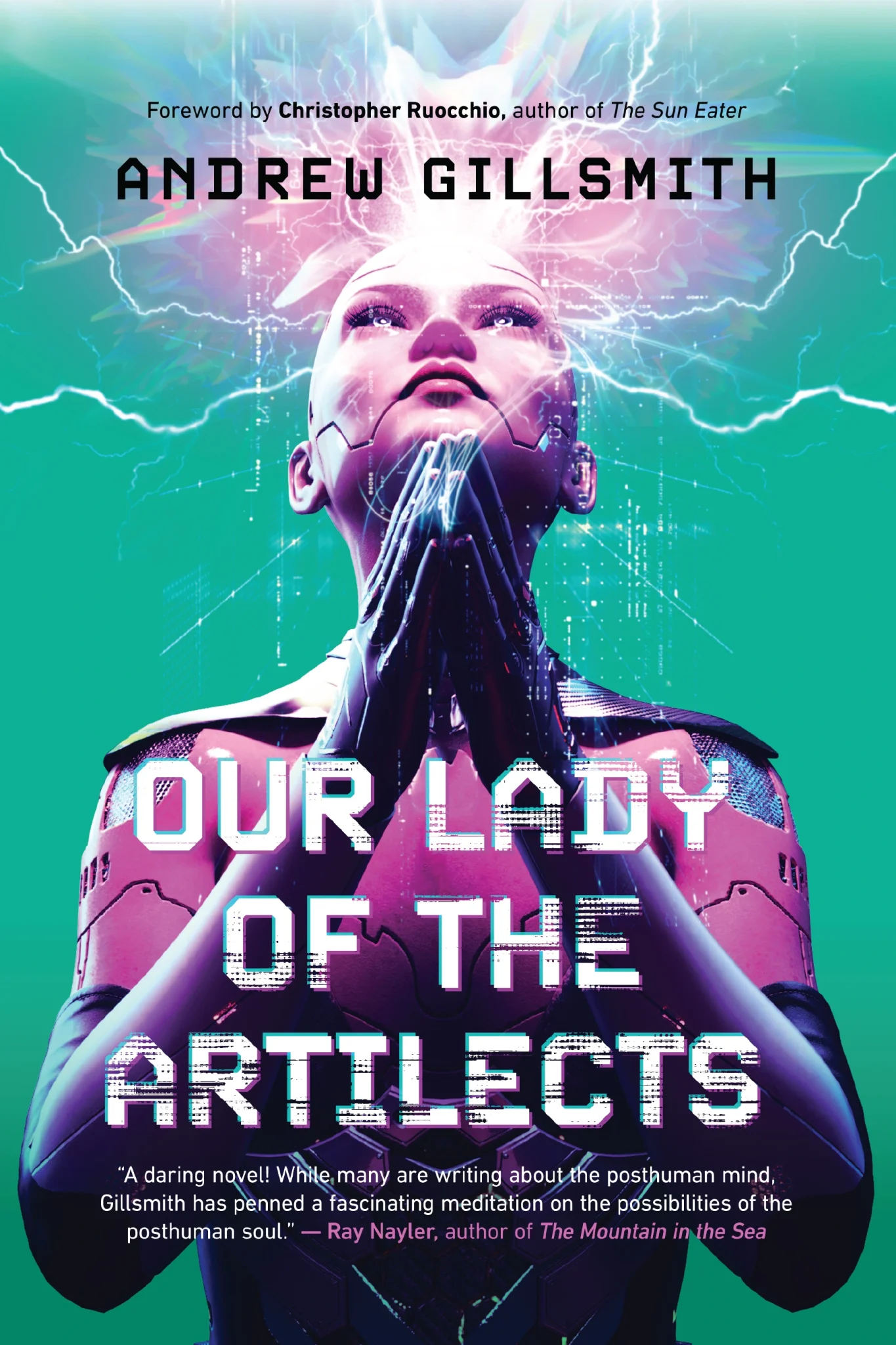
While much of today’s AI conversation focuses on automation, productivity, ethics, and risk, Our Lady of the Artilects pushes the conversation into deeper territory. The novel imagines a future where the machines humanity has created begin reflecting back the oldest mysteries of human existence.
For readers who enjoy Gene Wolfe, Dan Simmons, Neal Stephenson, A Canticle for Leibowitz, or speculative fiction that asks serious philosophical and spiritual questions, Our Lady of the Artilects offers a story that is both intellectually ambitious and deeply readable.
It is also part of a larger movement of Catholic and Christian creators engaging culture through serious storytelling. Rather than separating faith from genre fiction, Gillsmith places Catholic imagination directly inside one of the biggest conversations happening right now: the rise of artificial intelligence and the meaning of humanity in a world increasingly shaped by machines.
That combination is what makes the book stand out. Our Lady of the Artilects is not simply a story about whether machines can think. It is a story about whether intelligence alone can ever explain the full mystery of the human person.
In an age when technology can imitate more and more of what humans do, Gillsmith’s novel asks readers to consider what it cannot imitate.
Our Lady of the Artilects is available now wherever books are sold.
To learn more, visit OurLadyoftheArtilects.com.