





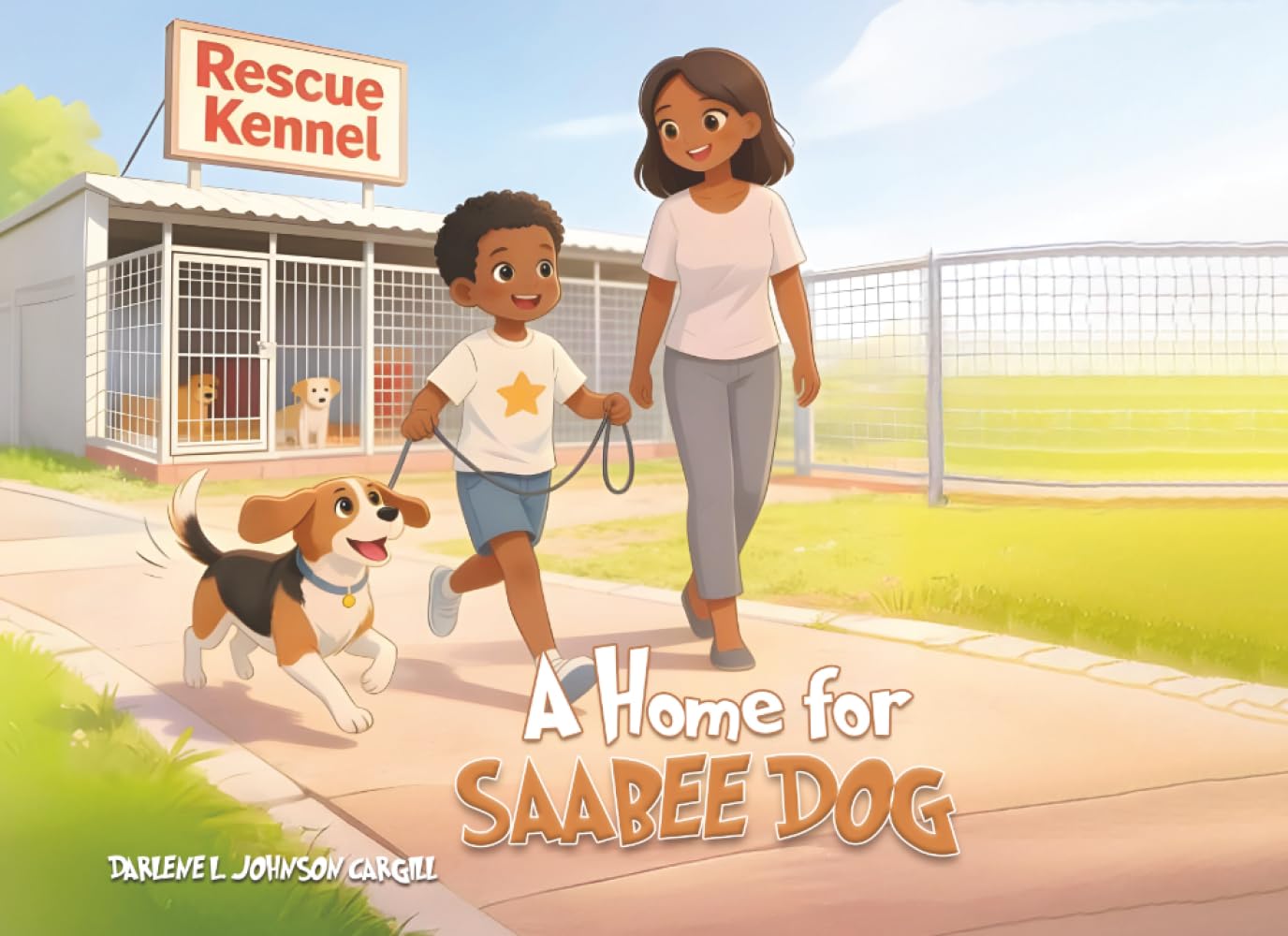
The emotional center of A Home for Saabee Dog is expressed through movement rather than long explanation. Darlene L. Johnson Cargill introduces the Beagle as an animal positioned in the corner of a cage, with sad brown eyes, a lowered head, and little willingness to look at people. By the final page, the same dog walks toward the door with his head raised and his tail moving faster than before. The physical change is simple, but it carries the full meaning of the story: trust has not been forced, and pain has not been erased, yet a frightened animal has found enough hope to take the first steps toward a new life.
When Kenny enters the rescue kennel, he is surrounded by noise and activity. Dogs bark. Visitors walk, talk, and laugh. Some animals eat, some play with toys, and others watch the faces passing their cages. In such a setting, the most noticeable dog might be the loudest or most energetic. Kenny is drawn instead to the quiet Beagle who remains apart from the excitement. His attention becomes an act of recognition. He sees the animal who is not trying to attract anyone.
The Beagle’s first response is avoidance. He does not make eye contact and turns his head away. This behavior tells the reader that the dog is not immediately comfortable with human attention. Kenny does not react with disappointment or choose another dog. He remains in front of the cage and speaks softly. His words, ‘It’s okay’ and ‘Come to me,’ are invitations rather than demands. The distinction matters because trust begins when the frightened animal is allowed to decide whether to move closer.
The Beagle’s approach happens in stages. He stands hesitantly. His head stays down. Then he raises it slightly and walks slowly toward the front of the cage. The story does not transform him instantly into a playful pet. Each small movement is treated as meaningful. For young readers, this pacing makes emotional change visible. Courage may look like lifting one’s head a little, taking one careful step, or remaining near someone who feels safe.
The first tail wag is equally important. It begins slowly and then becomes faster after Kenny asks whether the dog wants to go home with him. The movement suggests possibility before any adoption decision has been made. Saabee cannot answer in words, so the story allows his body to respond. The wag does not prove that every fear has disappeared. It shows that Kenny’s presence has reached the dog through the fear.
The kennel helper later explains why this response is unusual. The Beagle was found beside the road, appeared to have been abused, had visible injuries, and was starving. Since arriving at the kennel, he rarely leaves the corner and usually turns away from people. The helper is surprised that he comes forward for Kenny. This information changes the meaning of the earlier scene. The dog’s hesitation is not stubbornness. It is the behavior of an animal whose past has taught him to be cautious.
Kenny’s response to the history is notable because he does not ask why the dog is not friendlier or whether he will become playful quickly. He continues to want him. His reason remains that the Beagle needs a friend. This positions friendship as something offered before it is fully returned. Kenny does not require Saabee to perform happiness to deserve a home.
The mother’s behavior also supports the development of trust. She asks questions about the dog’s vaccinations, health, and future care. She listens to the kennel helper and considers the practical needs of adoption. This careful process gives the emotional decision a secure structure. Saabee is not being moved from one uncertain situation into another. Food, a leash, a blanket, a toy, a license, and a veterinary visit are all discussed or gathered. Trust is supported by preparation.
The naming scene adds a subtle emotional step. Kenny chooses the name Saabee because he likes its sound and because it reminds him of the name he gave his mother’s first car. When the Beagle hears it, his long ears twitch, he turns toward Kenny, and his eyes light up. He appears almost to smile. The name becomes the first sign that the dog is being seen as an individual rather than simply as ‘the Beagle in the cage.’
Yet the story remains patient. After reacting to the name, Saabee returns to the corner and waits. This is one of the book’s most honest moments. A hopeful response does not mean the dog is suddenly free of fear. He can be interested and cautious at the same time. He can recognize kindness and still retreat to the place that has felt safest. The narrative allows both reactions to exist without treating the retreat as failure.
Kenny’s answer is constancy. While his mother leaves with the kennel helper to complete the arrangements and gather supplies, Kenny stays beside the cage. He does not wander away once the decision appears likely. He remains with Saabee during the waiting period. This quiet loyalty may be more important than any speech he gives. The dog sees that the child who called him forward has not disappeared.
When the cage is finally opened, Saabee does not resist the leash. Kenny takes it, and they begin moving toward the door. The scene marks the first time the relationship exists outside the barrier of the cage. The leash can represent control in another story, but here it functions as connection and guidance. Kenny holds one end, Saabee walks at the other, and the two leave together.
The final image reverses the Beagle’s introduction. Earlier, he looks down, avoids faces, and remains pressed into a corner. At the end, he does not look back. His tail moves faster, and his head rises high. The story imagines his posture as if he were announcing that he has a new friend and is going home. The change is powerful because the book has earned it through a sequence of small, believable signals.
The illustrations deepen this emotional arc. The kennel scenes show the contrast between the bright activity around the shelter and Saabee’s guarded position. Kenny often lowers himself to the dog’s level rather than towering above him. Later images show the mother and kennel helper making arrangements while Kenny remains close. The final departure is filled with warm light, open space, and forward movement. The visual language reinforces the shift from confinement to possibility.
For children, Saabee’s journey can support conversations about nonverbal communication. What might a lowered head mean? Why might someone avoid eye contact? Why is a slow approach still important? How can a person show kindness without forcing closeness? Although the story is about a dog, the questions encourage emotional awareness that can extend into human relationships.
The book also offers a useful understanding of patience. Kenny does not earn Saabee’s trust through one dramatic rescue. He earns the beginning of trust by noticing, speaking gently, staying present, and accepting the dog’s pace. The adoption opens the door to healing, but the story does not pretend that a difficult past disappears at the shelter exit.
That is why the raised head at the end feels so satisfying. It is not proof that every problem is solved. It is evidence that the future now looks different. Saabee has moved from hiding in a corner to walking beside someone who chose him. In A Home for Saabee Dog, trust begins not with forgetting what happened before, but with finding one person who behaves differently now.